Docs Home
Source mirrored from
seocho/docs/README.md
SEOCHO helps agents use graph memory with an explicit ontology contract.
This page is the front door. It explains what SEOCHO does, which document to read first, and which words matter before you go deeper.
Start Here
Section titled “Start Here”| Goal | Read | You are done when |
|---|---|---|
| Understand the idea | Why SEOCHO | you can explain ontology-aligned graph memory in one paragraph |
| Run the smallest example | Quickstart | you can define one ontology, add text, and ask one question |
| Use Python directly | Python SDK | you know when to use local, remote, or explicit backend mode |
| Bring your own files | Bring Your Data | you know how your records enter the graph |
| Run a service | Runtime Deployment | you can start the API, UI, and graph services |
| Contribute | Open Source Playbook | you know how to open a scoped issue or PR |
If you only have ten minutes, read Why SEOCHO, then run the Quickstart.
Reader Map
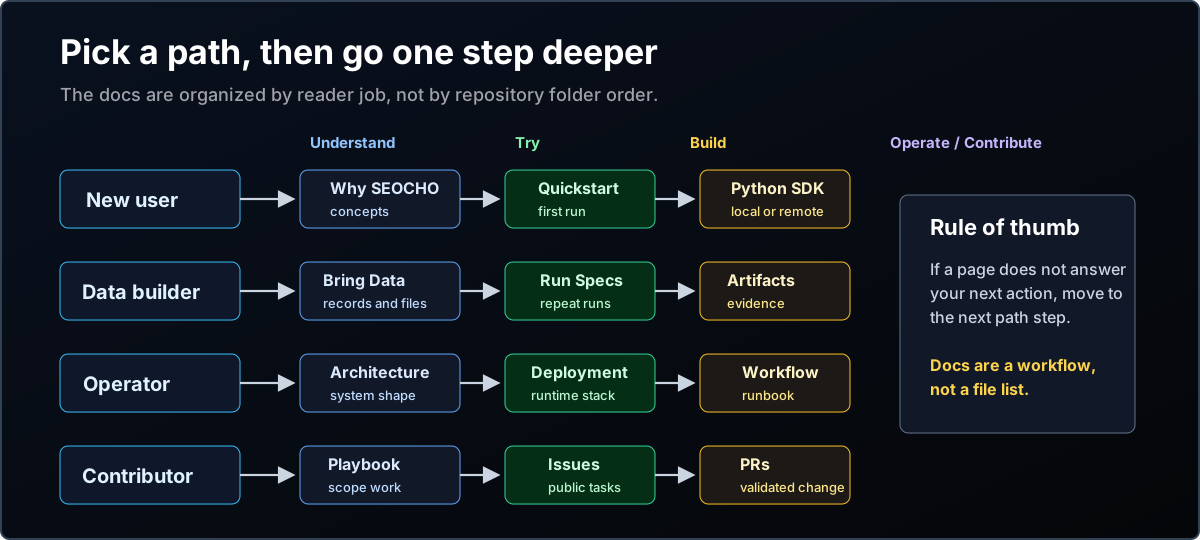
Section titled “Reader Map”Do not read the docs tree from top to bottom. Pick the path closest to your job and move one step at a time.
The Core Loop
Section titled “The Core Loop”SEOCHO keeps the same ontology contract across ingestion, graph writes, retrieval, answer synthesis, and runtime APIs.
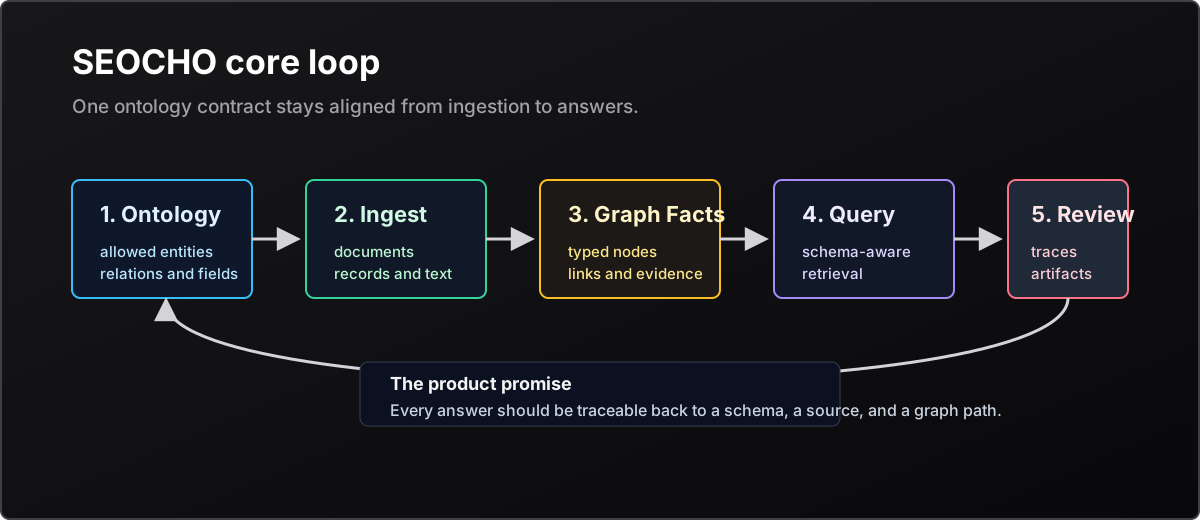
In plain terms:
| Step | What happens | What you can inspect |
|---|---|---|
| Define ontology | Name the allowed entities, relationships, and properties. | ontology file or Python object |
| Ingest data | Load text, records, or files. | input files and run config |
| Shape graph facts | Extract entities and relationships that fit the ontology. | graph payloads and validation notes |
| Query graph memory | Ask questions with schema-aware retrieval. | Cypher, evidence, and traces |
| Improve the contract | Review failures, add rules, and rerun. | artifacts, reports, and PRs |
Everything else in the repository exists to make this loop repeatable, observable, or deployable.
Quick Vocabulary
Section titled “Quick Vocabulary”| Term | Meaning here | Simple example |
|---|---|---|
| Ontology | The schema the agent must respect. | Person WORKS_AT Company |
| Graph memory | Stored facts plus provenance and constraints. | who said a fact, where it came from, and how it links |
| Indexing | Turning documents into graph-shaped facts. | extracting companies, incidents, controls, and relationships |
| Semantic query | Resolving intent before generating a graph query. | mapping “risk owner” to the right node and relation |
| Runtime | The HTTP service for shared usage. | an app or agent calls SEOCHO instead of local Python |
| Artifact | A generated file you can review. | trace, rule profile, report, or graph export |
Choose A Path
Section titled “Choose A Path”| Reader | Best first path |
|---|---|
| New user | Quickstart -> Python SDK |
| Data or RAG builder | Bring Your Data -> Run Specs |
| Agent developer | Python SDK -> Files and Artifacts |
| Operator | Runtime Deployment -> Workflow |
| Contributor | Open Source Playbook -> Issue Task System |
| Maintainer | Release And Community Operations -> Decision Log |
First Local Success
Section titled “First Local Success”The fastest path is local. It does not require Neo4j, DozerDB, Docker, or a web server.
uv pip install "seocho[local]"Then run the quickstart from a checkout:
export MARA_API_KEY=...uv run python examples/finance-compliance/quickstart.py --llm mara/MiniMax-M2.5Use the runtime later, when another process needs the same graph contract over HTTP.
Evidence And Artifacts
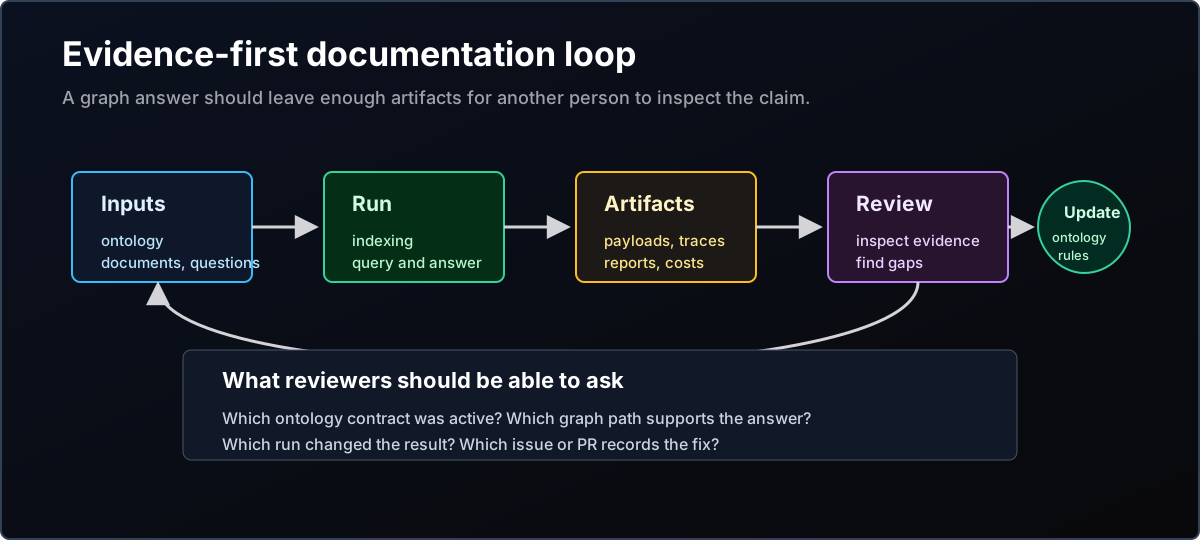
Section titled “Evidence And Artifacts”SEOCHO docs should make evidence visible. Every serious run should leave files or links that another person can inspect.
| Artifact | Why it exists | Read next |
|---|---|---|
| Run config | shows which ontology, documents, questions, and models were used | Run Specs |
| Graph payloads | show the nodes, relationships, and evidence before or after write | Files and Artifacts |
| Traces | show how retrieval, routing, and answer synthesis behaved | Files and Artifacts |
| Reports | compare runs, gaps, costs, and failure modes | Tutorial First Run |
| PRs and issues | keep public work reviewable and scoped | Open Source Playbook |
Document Map
Section titled “Document Map”| Area | Documents |
|---|---|
| Product idea | Why SEOCHO, Philosophy, Architecture Overview |
| Getting started | Quickstart, Python SDK, Bring Your Data |
| Repeatable runs | Run Specs, Tutorial First Run, Files and Artifacts |
| Operations | Runtime Deployment, Runtime Architecture, Workflow, Release And Community Operations |
| Open source work | Open Source Playbook, Issue Task System, Contributing |
The map follows this structure:
| Docs pattern | Purpose | SEOCHO examples |
|---|---|---|
| Concepts | explain why the system exists and which words matter | Why SEOCHO, Architecture Overview |
| Tutorials | guide a first successful run | Quickstart, Tutorial First Run |
| How-to guides | solve a concrete task | Bring Your Data, Run Specs |
| Reference | preserve contracts, surfaces, and decisions | Files and Artifacts, Query Architecture, Decision Log |
System Deep-Dive Map
Section titled “System Deep-Dive Map”Generated code indexes such as DeepWiki are useful as secondary maps, but the source docs in this repository remain the contract. Use this table to move from a system area to the maintained guide.
| System area | What you are trying to understand | Maintained docs |
|---|---|---|
| Product overview | why SEOCHO exists and where it fits | Why SEOCHO, Architecture Overview |
| SDK and client interface | how users call SEOCHO from Python | Python SDK, Quickstart |
| Ontology system | how schema, context, drift checks, and governance shape behavior | Why SEOCHO, SDK Ontology Guide, Maintainer Architecture Notes |
| Indexing and ingestion | how documents become graph facts | Bring Your Data, Run Specs, Files and Artifacts |
| Query and agent orchestration | how questions become evidence-backed answers | Query Architecture, Graph-RAG Agent Handoff Spec |
| Runtime and HTTP API | how the shared service is composed and operated | Runtime Deployment, Runtime Architecture |
| Storage and graph backends | where graph state, generated files, and backend assumptions live | Files and Artifacts, Runtime Architecture |
| LLM, tracing, and evaluation | how runs stay inspectable and how claims are validated | Files and Artifacts, Runtime Architecture, Workflow |
| Developer tooling and CI | how contributors keep changes reviewable and deployable | Open Source Playbook, Workflow, Maintainer Architecture Notes |
Current gap list:
| Gap | Current workaround | Good future doc |
|---|---|---|
| ontology internals are split across product, SDK, and maintainer docs | start from the SDK ontology guide, then read maintainer notes | Ontology Architecture |
| indexing/data-plane internals are spread across how-to and artifact docs | start from Bring Your Data, Run Specs, and Files and Artifacts | Indexing Architecture |
| graph backend details are mostly operational today | start from Files and Artifacts and Runtime Architecture | Storage And Backend Guide |
| tracing/evaluation guidance is distributed across workflow and runtime docs | start from Files and Artifacts, Runtime Architecture, and Workflow | Tracing And Evaluation Guide |
Common Questions
Section titled “Common Questions”| Question | Short answer | Read next |
|---|---|---|
| Do I need a graph database for hello world? | No. Start with the embedded local path. | Quickstart |
| When should I use the runtime? | When another app or agent needs a shared HTTP boundary. | Runtime Deployment |
| What does the ontology control? | It guides extraction, validation, graph writes, retrieval, and answers. | Why SEOCHO |
| Where do generated files go? | SEOCHO writes reviewable artifacts such as traces, reports, and profiles. | Files and Artifacts |
| Is debate mode the default? | No. Start with semantic graph QA. Use debate for explicit comparison. | Python SDK |
| How do GitHub, Ghost, and Discord fit together? | GitHub is source of truth, Ghost is the public archive, Discord is real-time discussion. | Release And Community Operations |
System Surfaces
Section titled “System Surfaces”| Surface | Owner path | Main question |
|---|---|---|
| Public SDK | src/seocho/ | how do users ingest, query, and configure SEOCHO from Python? |
| Query and retrieval | src/seocho/query/ | how does intent become graph-grounded evidence? |
| Indexing and graph shaping | src/seocho/index/ | how do documents become graph facts? |
| Runtime API | runtime/ | how do external agents and apps consume the graph contract? |
| Extraction compatibility | extraction/ | which legacy imports or batch paths still need to work? |
| Examples | examples/ | what should a real user copy first? |
| Docs and governance | docs/ | what contract should future contributors preserve? |
Deeper References
Section titled “Deeper References”Use these after the first local success:
| Topic | Reference |
|---|---|
| Architecture details | Architecture Overview, Runtime Architecture, Query Architecture, Maintainer Architecture Notes, Internal Class Design |
| Repository shape | Repository Layout, Workflow |
| Automation | GitHub Automation, Release And Community Operations |
| Design history | Decision Log, Reference Docs |
| Historical material | Archive, Maintainer Docs |
Docs Site Integration
Section titled “Docs Site Integration”- GitHub
README.mdis the fastest product landing page. docs/*is the source of truth for long-form product, operator, and system contracts.website/is the tracked Astro/Starlight source app in this repository.website/scripts/generate-docs.mjsmaterializes selected/docs/*and/blog/*pages from repo-root source docs for the in-repo site app.- Generated mirror files under
website/src/content/docs/docs/are derived site artifacts. Do not edit them by hand; regenerate them when source docs change. - Validate the site with
cd website && npm run check:docs && npm run build.